
The AI Engineer Blueprint
Your Complete Path from Beginner to Job-Ready
Go from AI beginner to building real-world AI systems with Python, NLP, LLMs, LangChain, LangGraph, Vector Databases, Speech Recognition and production-ready LLM engineering.
LLIFETIME ACCESS · DOWNLOADABLE LESSONS · SELF-PACED LEARNING · 10 COMPLETE MODULES
7-DAY REFUND POLICY
Stop Learning AI in Pieces
AI engineering is not one skill. It is a stack.
You need to understand the foundations of artificial intelligence.You need Python.
You need to know how natural language processing works. You need to understand LLMs, transformers, embeddings, RAG, vector databases, orchestration frameworks and how real AI applications are actually engineered.
And once you can build them, you still need to understand deployment, evaluation, security, cost, hallucinations, ethics and responsible production use.
The AI Engineer Blueprint brings all of that together into one structured path.

BUILD THE SKILLS OF A REAL AI ENGINEER
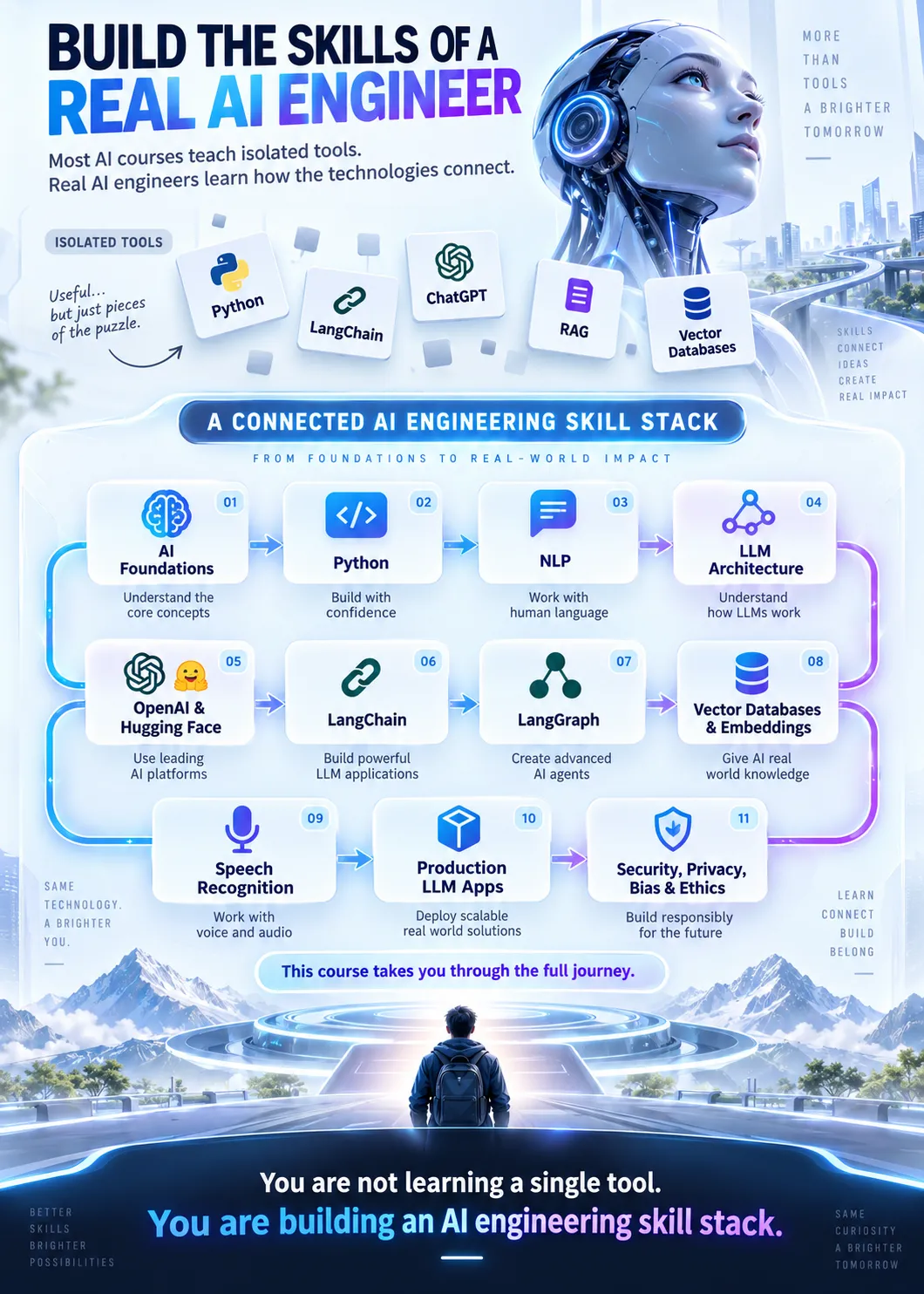
Most AI courses teach isolated tools.
One course teaches Python.
Another teaches LangChain.
Another explains ChatGPT.
Another shows RAG.
Another teaches vector databases.
But an AI engineer needs to understand how these technologies connect.
This course takes you through the full journey:
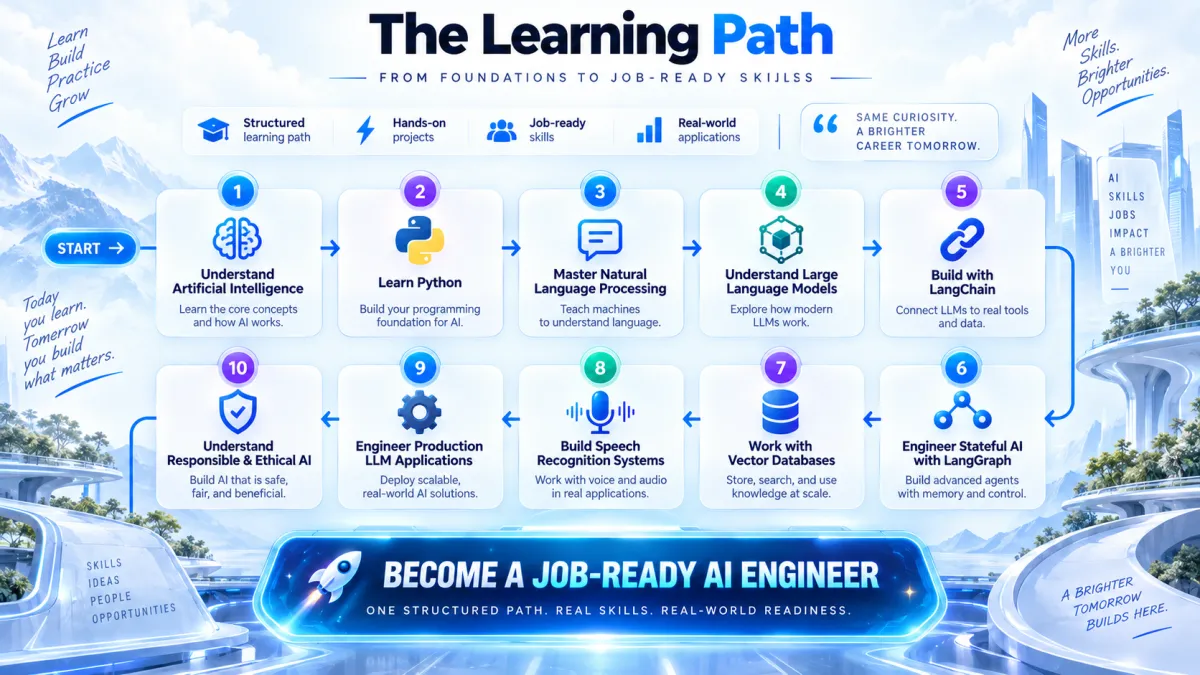
Understand the foundations of AI
Learn Python from the ground up
Work with NLP
Understand modern LLM architecture
Build with OpenAI and Hugging Face
Use LangChain
Build stateful systems with LangGraph
Work with vector databases and embeddings
Build speech-recognition systems
Engineer production-style LLM applications
Understand AI security, privacy, bias and ethics
You are not learning a single tool.
You are building an AI engineering skill stack.
BECOME A JOB-READY AI ENGINEER
Full Course Curriculum
Course Content
The AI Engineer Blueprint: Your Complete Path from Beginner to Job-Ready
Artificial Intelligence Foundations
Build a foundation in AI, data, machine learning, generative AI, the modern AI technology stack, and AI career paths.
42 lectures · 2h 36m 51s
Intro to AI: Getting Started
Data Is Essential for Building AI
Key AI Techniques
Important AI Branches
Understanding Generative AI, NLP and LLMs
Practical Challenges in Generative AI
The AI Technology Stack
AI Career Paths and Roles
AI Ethics and the Future
Python for AI Engineering
Learn Python step by step: set up Jupyter, write functions, work with data structures, use loops, and explore modules and documentation.
53 lectures · 3h 08m 23s
Getting Started with Python and Jupyter
Variables, Data Types and the Anaconda Assistant
Python Syntax and Operators
Conditional Statements
Writing and Combining Functions
Lists, Tuples and Dictionaries
Loops, Iteration and Practical Python Tools
Object-Oriented Programming, Modules and Documentation
Natural Language Processing
Explore language processing, sentiment analysis and topic modelling, then apply these techniques to a fake-news classification project.
19 lectures · 1h 08m 30s
NLP Foundations, Data Preparation and Sentiment
Topic Modelling: LDA and LSA
Text Classification Project: Preparation and Exploration
Fake News: Sentiment, Topics and Classification
Large Language Models
Move from deep learning and transformer architecture to GPT, Hugging Face, BERT, question answering and model fine-tuning.
47 lectures · 2h 41m 32s
Deep Learning and the Next Steps in NLP
Introduction to Large Language Models
Transformers, Embeddings and Attention
GPT and the OpenAI API: Building a Chatbot
LangChain and Custom Chatbot Data
Hugging Face Pipelines, Tokenizers and Models
BERT and Question Answering
Model Variants, XLNet Fine-Tuning and Evaluation
LangChain
Connect models, prompts and output parsers, compose runnable workflows, and build retrieval-augmented applications with your own documents.
51 lectures · 4h 04m 36s
LangChain Foundations, Business Applications and Pricing
Environment Setup and Your First OpenAI Chatbot
LangChain Models and Messages
Prompt Templates and Output Parsers
Chains, Batching, Streaming and Runnable Sequences
Parallel Runnables and Custom Chain Logic
RAG Foundations and the Document Pipeline
Loading and Splitting Documents
Embeddings and Chroma Vectorstores
Retrieval and Response Generation
LangGraph
Build stateful AI workflows with graphs, conditional routing, message management, checkpoints and persistent memory.
20 lectures · 1h 25m 42s
Getting Started with LangGraph
States, Nodes, Edges and Your First Graph
Conditional Edges and Routing
Reducers, Message State and Conversation Management
Checkpointing, Threads and Memory
Vector Databases
Understand vectors and similarity, manage Pinecone indexes, and build semantic search across a practical course-data case study.
29 lectures · 1h 56m 22s
Vector Database Foundations and Embeddings
Pinecone Setup, Indexes and Data Ingestion
Semantic Search: A Course Discovery Case Study
Updating Search Data and Comparing Embeddings
Recommendation, Image Search and Research Applications
Speech Recognition
Learn audio fundamentals and speech models, then transcribe, evaluate and improve audio workflows with Python and Whisper.
39 lectures · 3h 17m 28s
Introduction and Evolution of Speech Recognition
Sound, Audio Features and Signal Processing
Speech Recognition Models and Architecture
Python Setup and Working with Audio Files
Transcription and Evaluation with WER and CER
Spectrograms and Background Noise
Whisper, Batch Transcription and Text-to-Speech
Modern Applications, Limitations and the Future
LLM Engineering
Plan, build and deploy an AI interview application, then improve its prompts, reliability, security, costs and scalability.
43 lectures · 3h 18m 38s
Project Introduction, Model Choices and Token Economics
Prompt Planning, Database Design and Application Flow
Prompt Development and Testing
Streamlit Setup, Interface Elements and Session State
Building the AI Interview Application
Feedback, GitHub and Deployment
Application Architecture and Interview Prompts
Reliability, Security, Cost Reduction and Scaling
AI Ethics & Responsible AI
Explore ethical principles, responsible data and model development, practical business responsibilities, ChatGPT risks and global AI governance.
43 lectures · 2h 41m 12s
AI Ethics, the AI Lifecycle and the Law
Privacy, Transparency, Accountability and Fairness
Responsible Data Sourcing and Bias
Ethical Model Training and Development
Foundation Model Risks and Ongoing Monitoring
Responsible AI Adoption and Use
ChatGPT: Privacy, Misinformation and Wider Impacts
Global AI Regulation and Governance
Course Delivery
386 Lectures
26 Hours 19 Minutes of Training
10 Complete AI Engineering Modules
Beginner-to-Advanced Learning Path
Hosted on Thinkific
Desktop, Tablet & Mobile Access
Downloadable Video Lessons
Self-Paced Learning
Progress Tracking
Lifetime Access
How long does the course take?
The course contains approximately 26 hours 19 minutes of video training. It is structured as:
10 Weeks
1 Module, 5 Learning Days per Week
50 Learning Days Total
Because the course is self-paced, you can complete it faster or spread it over several weeks depending on how much time you spend building alongside the lessons.
WHAT MAKES THIS COURSE DIFFERENT
1. It Starts at the Beginning — But Doesn't Stay There
You do not need to arrive knowing Python, NLP or LLM engineering.
The course begins by explaining artificial intelligence itself:
What AI is
Machine learning
Deep learning
Generative AI
Data
AI branches
The AI technology stack
AI engineering
AI job roles
Then it progressively moves into increasingly technical material.
You are not thrown directly into frameworks without understanding what is happening underneath.
2. Python Is Taught as Part of the AI Journey
You don't get a five-minute Python refresher and then get told to keep up. The Python module builds the programming foundation needed for the later AI modules. You work through:
Python setup
Jupyter, Anaconda
Variables, Data types
Operators, Conditional statements
Functions, Lists
Tuples, Dictionaries
Loops, Iteration
Modules, Packages
Object-oriented programming
Documentation
The objective isn't to turn you into a general-purpose Python developer. It's to give you enough Python fluency to build AI systems confidently.
3. You Learn What Happens Under the Frameworks
This course doesn't begin and end with API calls. You'll learn concepts such as:
Neural networks
Transformers
Attention
Embeddings
Tokenization
RNNs
BERT
GPT
Fine-tuning
Retrieval
Vector search
Semantic similarity
Speech features
Audio processing
This matters because tools change.
Frameworks change.
Models change.
Understanding the concepts underneath them gives you skills that transfer.
4. It Moves from Fundamentals to Real AI Engineering
The later sections are where everything starts coming together. You go beyond theory into:
LangChain
LangGraph
RAG
Vector databases
Pinecone
OpenAI
Hugging Face
Streamlit
Speech recognition
LLM application architecture
Deployment
Session state
Prompt engineering
Cost optimisation
Hallucination mitigation
Prompt-injection awareness
Production considerations
The goal is not merely to know what an LLM is.
The goal is to understand how to build applications around one.
5. The Course Includes the Part Many AI Courses Ignore
Shipping AI responsibly is part of being an AI engineer.
The final module covers issues such as:
AI ethics
Privacy
Accountability
Fairness
Transparency
Intellectual property
Data sourcing
Bias
Responsible AI
Risk management
AI-generated content
Plagiarism
Misinformation
Privacy policies
Governance
Regulation
You learn not only how AI systems work, but what responsible implementation looks like.
6. It Builds Toward Real Job-Ready AI Engineering Skills
The course is designed to move beyond simply understanding AI concepts.
As you progress, you begin working with the same types of technologies and workflows used in real AI engineering environments:
Python
APIs
NLP
LLMs
LangChain
LangGraph
Vector databases
Speech AI
Streamlit
Model evaluation
Deployment
Security and responsible AI
It is on helping you understand how to design, build, test, connect and improve complete AI systems — the kind of practical skill set you can apply to projects, portfolios, technical interviews and real-world AI engineering work.

FROM BEGINNER TO JOB-READY
Being job-ready does not mean memorising every framework.
It means being able to:
Understand a technical problem
Select the appropriate AI approach
Work with Python
Understand data
Work with APIs and models
Build applications around LLMs
Use retrieval systems
Understand vector databases
Create stateful workflows
Evaluate results
Debug problems
Think about cost
Think about reliability
Think about security
Explain your decisions
Understand responsible AI
That is the path this course is designed around.
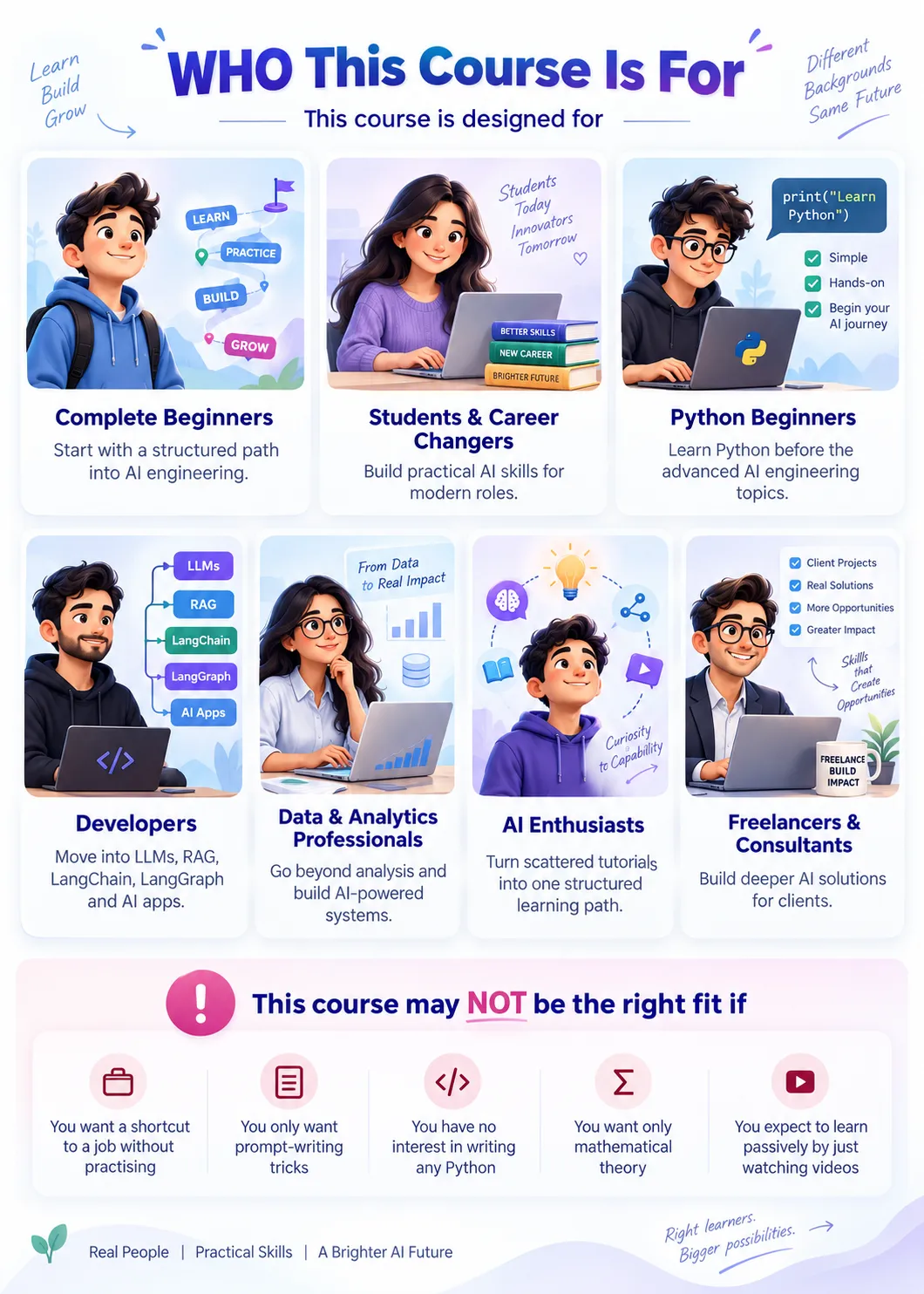
Who is this Course For ?
This course is designed for:
Complete Beginners : If AI engineering interests you but you don't know where to start, the course gives you a structured sequence instead of expecting you to piece everything together yourself.
Students & Career Changers : If you want to develop practical AI skills and understand the technologies appearing in modern AI engineering roles.
Python Beginners : If you've avoided AI engineering because you weren't confident with Python, the course includes a substantial Python foundation before the advanced material begins.
Developers : If you already code and want to move into LLMs, RAG, LangChain, LangGraph, vector databases and modern AI application engineering.
Data & Analytics Professionals : If you want to move beyond traditional analysis and begin building AI-powered systems.
AI Enthusiasts : If you've learned from dozens of disconnected tutorials and now want one structured path from fundamentals through advanced engineering.
Freelancers & Consultants : If you want to understand the technologies behind modern AI applications so you can build more sophisticated solutions for clients.
THIS COURSE MAY NOT BE THE RIGHT FIT IF:
You want a shortcut that promises a job without practising
You only want prompt-writing tricks
You have no interest in writing any Python
You want only mathematical theory without building applications
You expect AI engineering to be mastered by passively watching videos
What You Need Before You Start
You do not need previous AI engineering experience.
You do not need previous NLP, LangChain, LangGraph or vector-database experience.
You'll need:
A computer
A reliable internet connection
The willingness to work through Python
Time to practise alongside the lessons
Accounts for external tools and APIs when required
The learning path is designed so the technical complexity increases gradually.

Frequently Asked Questions
Q:
Do I need previous coding or AI experience before starting this course?
No. The AI Engineer Blueprint is designed to begin at the foundation level and gradually move into more technical AI engineering topics. You start by understanding artificial intelligence, machine learning, deep learning, generative AI, data, and the modern AI technology stack before moving into Python, NLP, LLMs, LangChain, LangGraph, vector databases, speech recognition, and production LLM engineering.
The Python module is included specifically so learners are not expected to arrive with strong programming experience. You will cover variables, data types, operators, functions, loops, lists, dictionaries, modules, packages, object-oriented programming, and other concepts needed for the later technical modules.
You will still need to practise alongside the lessons, especially once you reach Python and application-building sections, but you do not need a computer science degree or previous AI engineering experience to begin.
Q:
What will I actually be able to build after completing the course?
The course is designed to help you progress from understanding AI concepts to building practical AI-powered applications. You will work with Python, NLP workflows, pre-trained language models, OpenAI APIs, Hugging Face, LangChain, LangGraph, vector databases, embeddings, retrieval systems, speech recognition, Streamlit applications, and production-style LLM engineering concepts.
You will learn how to create chatbots, work with custom data, build retrieval-augmented generation workflows, use vector search, manage state and memory, process documents, create semantic-search systems, work with speech-to-text technologies, and structure complete LLM applications.
The course also covers reliability, hallucinations, prompt injection, cost management, deployment considerations, privacy, bias, fairness, and responsible AI, so the focus is not only on getting a demo to work but on understanding the wider engineering process around it.
Q:
suitable for someone who wants to become job-ready in AI engineering?
The course is structured around many of the technical areas commonly associated with modern AI application development, including Python, NLP, transformers, LLMs, APIs, embeddings, RAG, LangChain, LangGraph, vector databases, speech systems, application architecture, deployment, model evaluation, security, and responsible AI.
Rather than focusing on a single framework, the curriculum is designed to help you understand how the different parts of an AI system connect. This is especially useful when building portfolio projects, preparing for technical discussions, understanding AI engineering workflows, or moving from general software or data work into AI-focused development.
However, completing a course alone does not guarantee employment. Becoming job-ready also requires practice, independent projects, problem-solving, and the ability to explain and apply what you have learned in real technical situations.
Q:
Which technologies, frameworks, and AI concepts are covered?
The course covers a broad AI engineering stack rather than concentrating on one tool. You will work with or learn about Python, Jupyter, Anaconda, OpenAI, Hugging Face, LangChain, LangGraph, Pinecone, Streamlit, Whisper, APIs, embeddings, vector databases, transformers, BERT, GPT, RAG, semantic search, speech recognition, and model evaluation.
You will also study important underlying concepts such as machine learning, deep learning, NLP, attention, tokenization, foundation models, fine-tuning, retrieval, state, memory, output parsing, prompt structure, vector similarity, audio features, WER, CER, cost optimisation, scaling, hallucinations, and prompt injection.
The final part of the course extends beyond development into AI ethics, privacy, transparency, accountability, fairness, data sourcing, intellectual property, governance, regulation, and responsible AI deployment.
Q:
How is the course structured and how long will it take to complete?
The course contains 10 major modules, 386 video lessons, and approximately 29 hours and 46 minutes of training. It begins with AI foundations and Python, then progresses through NLP, LLMs, LangChain, LangGraph, vector databases, speech recognition, LLM engineering, and AI ethics.
Because the course is self-paced, there is no single required completion schedule. Some learners may move through the introductory sections quickly, while others may spend significantly more time practising Python, reproducing examples, experimenting with APIs, building projects, and reviewing advanced engineering topics.
The actual learning time will therefore be longer than the video runtime if you actively practise, which is recommended. You can move through the material at your own pace and revisit earlier modules whenever you need to strengthen a particular concept.
Q:
How is the course delivered, and will I have long-term access to the lessons?
The course is delivered online through Thinkific, giving you a structured learning environment where you can move through the modules and lessons at your own pace. The video lessons are designed to be accessible on desktop, tablet, and mobile devices, allowing you to study according to your own schedule.
The course is self-paced rather than cohort-based, so there are no mandatory live class times or fixed weekly deadlines. You can revisit technical lessons when you are working on Python, LangChain, LangGraph, vector databases, speech recognition, or LLM applications and need to review a concept.
The course is also designed as a long-term reference path, so you can return to individual modules as your projects become more advanced and use the curriculum to reinforce the parts of the AI engineering stack you need most.
Get in touch with us
Have a question about courses, learning paths, or where to start? We’re here to help. If you’re unsure which skill track fits your goal, reach out and we’ll guide you with clear recommendations based on your current level and what you want to achieve.
You can message us anytime for course details, upcoming program updates, pricing, and access. For faster support, share your goal (job, freelance, business growth, or skill upgrade) and we’ll respond with the best next steps.
+44 7470 591157
46 Stuart Road, RIchmond, Surrey, England, TW10 7QR
Monday - Friday, 8:00 am - 5:00 pm (UTC)

Follow Us
Upgrade your skills with structured digital learning built for real progress. Explore in-demand online video course, follow clear step-by-step paths, and keep improving with clarity. Whether you’re a student, professional, or creator—start today and build skills that truly matter.
Quick Links
Important Links
Contact Us
+44 7470 591157
46 Stuart Road, RIchmond, Surrey, England, TW10 7QR
- Monday - Friday, 8:00 am - 5:00 pm
© Copyright 2026. All rights reserved. DigitalSkillOrbit is a trading name of TeamForge Marketing Advisory LTD, Registered in England & Wales No. 17379672